LUMI Reviews Castration Movie iii.ii This town needs a castration!
16 September 2026
LUMI Programmer Faye B programmed Castration Movie Chapter iii.ii as a part of the Fix Your Hearts season at QFT. It may have broken her.
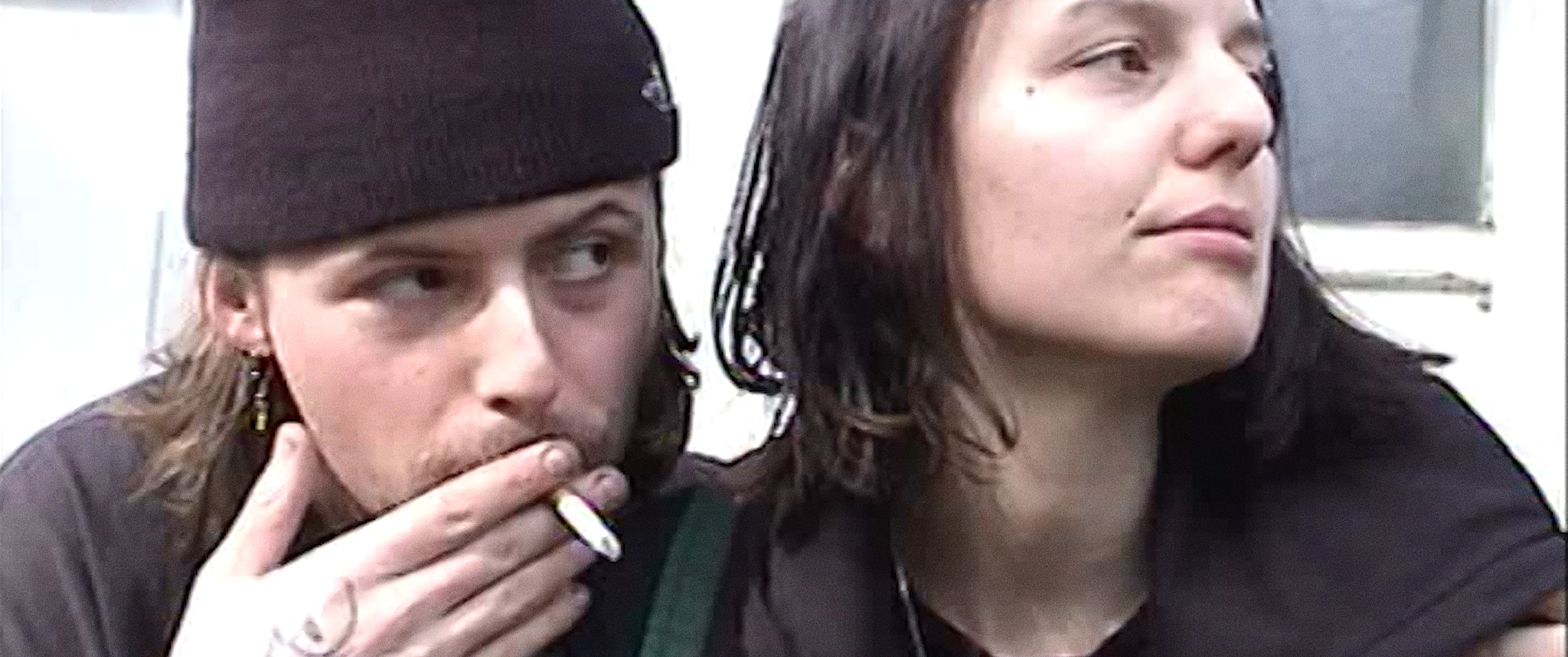
In 2024, Toronto filmmaker Louise Weard began a sweeping epic project. Provocatively named and even more inflammatory in content, Castration Movie has expanded into, at present, an over-12-hour cinematic universe dramatising the experiences of trans women in both her own city and in New York.
I’ve spoken at length about my thoughts on the previous two major entries, but for those who don’t follow my more unprofessional criticism: the films excel in their refusal to shy away from upsetting — or downright torturing — the viewer, however the long-take improvisational style and often grating edgelord humour cause Weard to fall short (if anything about the five-hour anthologies can be called short) of her full potential. I’ve remarked that the second film could stand to shave off an hour to reach a lean 240 minutes. This newest entry, though…
The film, largely its own story but strengthened in isolated scenes by having seen the first anthology, follows a newly-out trans woman who rapidly begins to actualise this awakening, against the growing resistance of her long-term partner.
I don’t want to be hasty, and I may be slightly inflating my opinion because of how much I adored screening the film, but itthe film is practically everything I’ve ever wanted from a coming-out story. Weard has finally fully realised the potential of the stylistic project that she began in 2024. Initially this film was set to be the first 40% of Anthology III, but the decision to separate it appears (and we can fully evaluate once Year of the Hyena releases) to have been the right one.
Castration Movie Chapter iii.ii: Junior Ghosts, Premorphic Drift; a fragmentary passage makes a very bold choice. This is not a film about a trans woman fighting for acceptance at the start of her transition. Weard has elected to centre the whole narrative on increasingly hostile transphobe character, Izzy (Avalon Fast.) Now, this is a decision that will rub many the wrong way. In fact, I think one woman I met after the screening said it was the most transphobic film she’d ever seen.
The decision, however, has paid dividends. For one, Fast excels in the role. She’s very skilled at keeping her position on Tiffany’s (Henri Gillespi) transition in a constant apparent ebb and flow, especially in the earlier days. As the film progresses, and she’s allowed to ramp up her hostility, Fast only reveals more and more of her talent. Many performers in the previous entries, regrettably, struggle to improvise compellingly, but Fast is almost distractingly engaging. One needs only compare the bookending scenes of Tiffany and Izzy’s story, both with Fast at her work desk answering a call from two different women seeking mental health support, to see a phenomenal display of both massive range and profound subtlety and guile.
There’s a greater reason why the controversial choice was undoubtedly the right one, but first I’d like to dive into Gillespi’s comparably fantastic, yet qualitatively antithetical portrayal of Tiffany. In discussion with a friend, I half-joked that his performance so excellently captures the deadness of the eye so often seen in a repressing transsexual that we should expect to hear a major personal announcement in the coming years. Obviously, I’m not seriously contending that good acting is impossible in the absence of lived experience, but Gillespi certainly captures something far more uncomfortably familiar about repression than, say, I Saw The TV Glow’s Justice Smith.
It’s this complete stonewallish detachment, this Brechtianism that allows the film to unveil its real brilliance. Throughout the film, the suddenness of Tiffany’s coming out and her subsequent haste in reordering her life to match her new self are questioned. She’s out of work, she’s spent the past 6 months in the house doing nothing; is she just doing all this to feel like she’s moving forward in an otherwise stagnated life? A film more anchored to Tiffany would likely answer this question with a whole-hearted no, and it certainly wouldn’t be wrong, exactly, to do so.
It’s a lit firework of an idea to put forward, arguably even irresponsible in the current climate. I’ve seen that criticism levied in some discussion of the film. In my view, such a critique falls flat when considering two key facts: this is the third main instalment in the Castration Movie series. There are, generously, ten cis people total watching this, and half of them were at the screening.
More significantly: the film doesn’t pretend that Tiffany not being “truly” trans would matter at all. It wouldn’t excuse Izzy’s cruelty, or invalidate her right to present as she chooses. In fact, I think this film is, if anything, a rhetorical boon, reinforcing and highlighting the bodily autonomy line of argument toward which I’ve long held queer activism needs to pivot.
It’s here where the paradoxical nature of the film lies: on its face it’s a huge escalation of the hostility and nastiness present earlier in the series, yet beneath, it’s surprisingly tender in a way I didn’t expect the muted Hi8 video and vicious humour could accommodate.
And believe you me, it is an incredibly funny film, albeit in concentrated doses. There’s a verbal standoff between Weard’s character Michaela, originating in the first anthology, and Sepi Mashiahof and Camp Miasma director Jane Schoenbrun’s characters Tweedle and Kane that, partially owing to its immediacy in following some truly harrowing transphobia, that had the whole audience in seam-splitting peals of laughter.
An undermentioned virtue of this film relative to prior entries in the series is a far more judicious approach to the Internet. If you’ve read my interview with Joi Jolyne Segreto and Aja Vail, published in the accompanying season zine This Booklet Contains Transsexual Cinema, you’ll have seen discussion of the overreliance on online stories in trans cinema. This is one of my major faults with prior entries in the series; I don’t want to watch a character scroll 4chan or hear that the antagonist of the film is a YouTuber. Enough! Fortunately, the existence of the Internet is largely limited to one groan-inducing scene of Izzy scrolling mumsnet. The restrained approach to technology afforded me far greater investment than when Weard refuses to Get Off the Damn Computer.
Weard’s proficiency behind the camera has also leapt and bounded in the short time since The Best of Both Worlds. Where before the cinematography felt rather aimless and floaty, she’s since become far more intentional in what we look at and when. I’m still not wholly convinced that the Hi8 camera was the right one for the project, excepting the beautiful nighttime footage. Perhaps more of a lighting issue than anything; I was sent a screener for an upcoming Hi8 feature with a more lurid approach to lighting that counteracts the camera’s strong, almost lifeless desaturation.
If you’ll permit me to stray somewhat personal… I understand why a great deal of coming out stories, particularly trans-centred, skew more optimistic. I get that my sisters need to be reassured, that they need to hear about the great deal of beauty that awaits them once they allow themselves to live. That said, I have seen what happens when you come out. I’ve noticed the people who used to constantly call me by the name they knew me under and all of a sudden reduced me to just “hey, you.” I know the look in the eyes. I know what it is to become a thing.
And maybe that’s why I’m so glad this film exists. A film that’s not afraid to grab you by the shoulders and tell you that transition will ruin your life, but it’ll give you a life to ruin.
Audiences in Europe can now stream the first two instalments of the Castration Movie anthology via the Matchbox Cine Online Cinema, where access materials including Audio Description and Descriptive Subtitles are also available.
Alternatively, previous installments in the Castration Movie series are also currently available on Gumroad, with Chapter iii.ii Junior Ghosts, Premorphic Drift; a fragmentary passage available in November.