50 Years of Queen’s Film Theatre
By Sam Manning, Sight & Sound, Fifty Years of Queen’s Film Theatre
11 September 2018
On 16 October 1968, Queen’s Film Theatre (QFT) opened in a converted lecture theatre at QUB
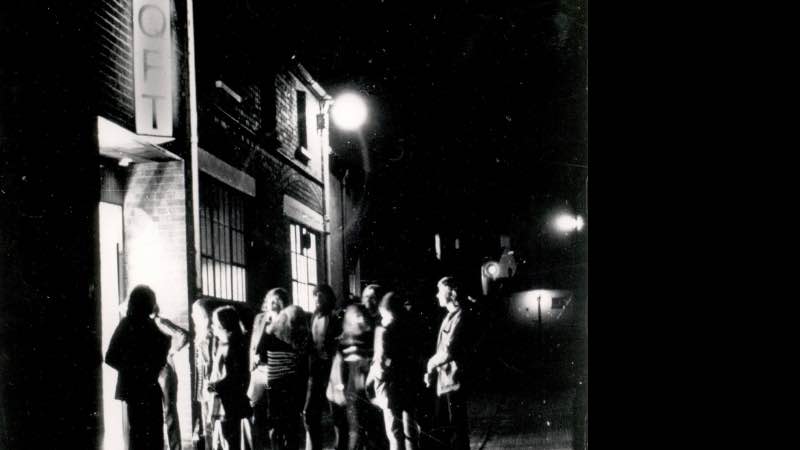
QFT entrance 1970s
In 1968, Queen’s University Belfast (QUB) student newspaper The Gown claimed that, other than the university film society, ‘there is virtually no cinema in Belfast that shows any films other than John Wayne or Julie Andrews spectaculars’. History lecturer Michael Barnes and Belfast Festival Director Michael Emmerson filled this lacuna, creating an independent cinema similar to the BFI-funded Regional Film Theatres. On 16 October 1968, Queen’s Film Theatre (QFT) opened in a converted lecture theatre at QUB with a gala premiere of Louis Malle’s Viva Maria! (1965). Later this year the cinema will celebrate its 50th anniversary with a range of screenings, lectures, exhibitions and events.
In its first years of operation, QFT screened a range of international films based on artistic merit rather than on commercial appeal. It quickly became clear that, though an important cultural asset, QFT was not a sound financial proposition. It remained open thanks to new sources of finance and the astute management of long-term administrator Michael Open (1969-74, 1977-2005), whose complaints that QFT received less funding than its UK counterparts often fell on deaf ears.
While QFT’s south Belfast location was largely free from sectarian violence, the Troubles impacted its programming and operations. In 1970, for instance, the Film Theatre Committee reported that a recent run of poor attendance was ‘largely due to the civic unrest in Belfast’ and, in the following year, the cinema decided to withdraw The Battle of Algiers (1966) from its programme. Furthermore, the 1974 Ulster Workers’ Council Strike led to two weeks of closure. It did, nevertheless, fare better than many other Belfast cinemas and offered a safe haven during a period of conflict. In 1977, it escaped a series of IRA firebomb attacks which damaged three Belfast cinemas.
One of QFT’s most idiosyncratic features was its gloomy and concealed rear-alleyway entrance which, alongside a lack of geographical mobility during the Troubles, limited visibility and restricted passing trade. In spite of these limitations, it attracted cinephiles from all parts of Belfast. Filmmaker Brian Henry Martin grew up in east Belfast and recalled seeing Jean de Florette in the mid-1980s: ‘I don’t think I’d ever been to south Belfast.… it was quite foreboding going up the alleyway, you thought something terrible was going to happen and you turned around the corner and there was this little bright entrance and in you went to this completely different world’.
The rise of home video led UK cinema audiences to reach their nadir in the mid-1980s. In contrast to national trends, QFT survived and prospered – In 1983, Open reported that despite a lack of funding or capital investment, patrons are ‘frequently astonished at the high quality of the programming and the high levels of audience in spite of the local civil unrest and spartan conditions of the building’. Troubles drama Cal (1984) broke attendance figures and QFT welcomed high-profile visitors such as David Puttnam and Alan Parker. Dolby Sound was introduced in 1986 and a year later new projectors and cinema seats were installed, replacing the uncomfortable lecture-style seating. Prior to this, Open suggested that patrons had to be ‘tolerant as well aesthetically astute to embrace the QFT experience’. The conversion of another lecture theatre in 1988 allowed the cinema to diversify its programming and provide a greater range of specialised films.
In the 1990s, QFT successfully faced the challenge of the new Belfast multiplexes and retained its status for serving residents with the best of contemporary cinema. Yet its facilities still did not match the standards of its programming. This was addressed in the early noughties when an extensive refurbishment introduced a new café/bar and the gloomy entrance was relocated to a more glamorous location facing the university campus.
In recent years, under the leadership of Susan Picken (2008-2017), and now Joan Parsons, QFT has diversified its programme and regularly hosts events such as Cinemagic, the largest film festival for young people in the UK and Ireland. Film critic Mark Kermode appears annually at QFT and described a screening of Jeremy as one of his ‘most profound cinematic experiences’. Furthermore, the introduction of dementia and autism friendly screenings provides a valuable service for groups previously excluded from cinema exhibition.
QFT’s 50th anniversary provides an opportunity to celebrate its achievements and to reflect on the role of cultural cinema in Northern Ireland. Over the past fifty years it has survived a range of challenges including the Troubles, declining cinema attendances, and the rise of home video and on-demand streaming services. It continues to provide a great deal of enjoyment for cinema-goers in Belfast and beyond.
[Source: Sight and Sound 2018, reproduced from Sam Manning's article]
Explore the full QFT50 programme here https://queensfilmtheatre.com/qft50