LUMI Reviews: Badlands
18 May 2026
LUMI Programmer Steven Burrows digs deep into their May pick Badlands.
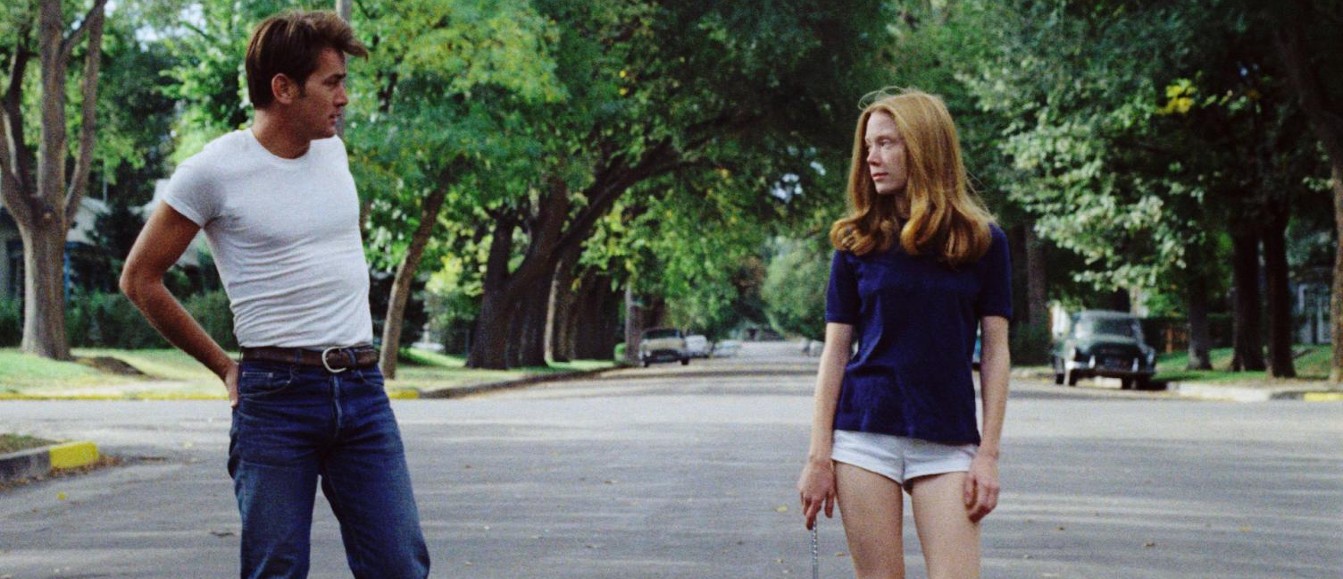
badlandsbanner.jpg
Arriving at a turbulent time in American cinematic and cultural history, right at the heart of New Hollywood, Terrence Malick’s Badlands (1973) brings Martin Sheen’s Kit Carruthers and Sissy Spacek’s Holly Sargis across the endless badlands of Montana. Malick’s debut feature instantly solidifies much of his cinematic language, a singular ability to capture nature, pensive and ethereal narration, and a specific interest in troubled young American men and the consequences of their behaviour. Kit is perhaps Malick’s most layered male figure, who are often victims of the American government, their locale and older men. While Kit goes to greater lengths to prop up his own mystery than any of Malick’s leads, he is also the most insecure and volatile.
Malick tends to begin with the practical man forced to spiritually expand, centring on soldiers, farmers, settlers, and it’s the same in his debut. We meet Kit working as a garbageman, clearly going for his best James Dean look (later, a cop who arrests him says he’s the spitting image, and it’s the happiest Kit appears). He then meets Holly, and immediately reveals his two most important features, impatience and vanity, taking no time trying to charm her and determine how Holly should see him and his job, “I’m not in love with the stuff, okay?”. Kit is the great American posturer, seeing himself as one of very few who have something to say, and believing he is one of even fewer who deserves the space to say it.
His want for any kind of celebrity leads him on a killing spree with Holly, drawn into this role alongside him and incapable of doing much about it given her young age and Kit’s drive. Murderers, serial ones specifically, were the true American celebrities of the 70s, and that’s where Kit sees his opportunity. His pursuit maintains an explicitly transactional nature with his status, extreme action for extreme attention, and it’s where Malick gets to the heart of this burgeoning American identity of the mid-1900s. Joseph E. Davis, in The Commodification of Self (2003), presented evidence from Ralph Turner (1976) on “a shift in the way that Americans conceive of and express themselves… a shift in the locus of self”. He determined that Americans were no longer defining themselves by social and institutional positions, but rather through “internal criteria and impulse” and how the “real self” is a personal reality that is now comprised of “deep, unsocialised, inner impulses”. This aligns with Kit, given his erratic behaviour throughout, failure to fall into institutional expectations and his dedication to his own image regardless of sacrifice.
The text also points to the idea of mass-marketing’s introduction of self-determination, commodifying authenticity and turning products into ideas of rebellion and individuality. Of course, Kit isn’t simply looking the part and going about his day, he is engaging in spontaneous and violent acts, but these too are false images. Nothing is towards a political goal or statement. He is friendly with the cops and National Guard, succumbing to his own desire to charm and charm widely. He wants to be the American rebel, but he also wants to be liked. Even in his most intimate moment, slow dancing with Holly to Nat King Cole’s A Blossom Fell, Kit can only express himself in one way, channeling the understanding of his feelings through a “hit” song, something to be widely embraced by the public. That line is perhaps the strongest in Malick’s entire catalogue, and it is a deeply emotional sequence, but it also totally reveals Kit as the sad and ultimately shallow young man he is (further complemented by Holly’s cold gaze and physical submission). Davis, unpacking emotional commodification, explores the American interest in “maximising exchange value… staying “relevant” like the great brands… qualities must be constantly monitored and adjusted to retain the desired image”, which comes through Kit’s cool and almost blasé self-assessments to others. Malick notably does absent one feature of the conversation around American commodity though, capital, given Kit’s apparent disinterest in money. However his capital is status, and he attains it briefly, at the cost of his own life and those of many more.
Though Badlands recognises the horrific nature of the country it was born from, and the unrelenting violence of many New Hollywood films it would be mentioned alongside, it also sees the beauty of the world and looks for a deeper interiority in its people. Malick unravels this violent odyssey in emotional and spiritual detail but unlike many of its contemporaries opts for distant and instant acts of violence over graphic, and makes room for intimate musings on the world and paths that might have been. These maintain Kit and Holly’s romanticised ideas of their journey, but because the spectator can see her expected naïveté, and his clearly warped psyche, the film doesn’t get sucked into their perceptions. Malick attempts a fine balancing act and totally succeeds, unearthing the new American identity and his own cinematic language.