Marilyn Monroe 100: The Misfits
By Hugh Odling-Smee
06 July 2026
The Misfits is the final completed film of Marilyn's short career. Around a year after the making of the film, Monroe would be dead and we would be left to interpret and argue over her legacy to the present day.
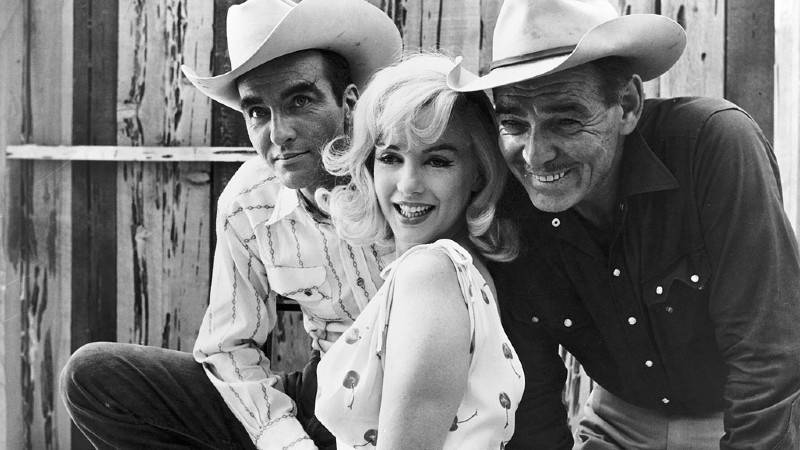
The Misfits is often seen through the prism of the tragedy of a screen icon dead at 36 and the film was destined to be overshadowed by the death of its three main stars.
Clark Gable would die weeks after the production finished, his damaged heart giving out after the strain of performing his own stunts in the Nevada desert and Montgomery Clift would die in 1966 five years after the film’s release. The film has therefore become a kind of cinematic mausoleum. It has also been overshadowed by the doomed marriage of Monroe and the film's writer, the great American playwright Arthur Miller, which has bewitched gossip columnists and biographers and indeed Miller himself, judging by how many times he returned to his relationship with Monroe after her death.
This newly restored version from 2020, allows us to reappraise the film. I would argue that The Misfits, whilst of course a storied part of Hollywood history because of the people who made it, is also a film that should be seen as a classic in its own right - a bleak and moving story of the dying of the western dream, an acute analysis of masculinity and a brilliantly directed, visually interesting film from one of the finest directors of the 20th century.
The story of how The Misfits came into being begins with divorce. Arthur Miller was in Reno in 1955 living out the residency period required to gain a six-week divorce from his first wife, Mary Slattery, just as Monroe’s character Rosalyn is in the film. Filling his time, Miller fell in with two rodeo riders who took him out to the salt flats of Nevada and showed him the cowboy life. These two men also told him tales of mustanging, capturing wild horses to be sold for dog meat.
Miller then wrote a short story which was published in Esquire magazine in 1957 which featured the three main characters Guido, Gaylord and Perce, but only mentioned a mysterious woman called Roslyn, a simmering presence who remains off stage. It’s here that Miller finds his hook, the men’s degrading hunt for wild animals to sell to companies like Ken-L Rations who would package it as ‘lean, red meat’ for the developing suburban America’s pet dogs. A twisted version of the manly ideals of the west as Miller saw it, and getting to the heart of the west - the exploitation of nature for profit, in the name of individual freedom.
As he and Monroe’s relationship developed into marriage, Miller decided, in the way that husbands did in the 1950s, that she needed a serious role that would allow her to apply her abundant acting skills. Taking the bones of the short story, he worked up what he called a ‘cinema-novel’ developing the role of Roslyn specifically for Marilyn. The novel was then sent in draft form to John Huston in Ireland who agreed to direct and casting for the male roles was put in place. Clark Gable was chosen to play Gay Langland. At first Gable, then 59, was nonplussed by the script, ‘it’s supposed to be a western, but it’s not is it?’ To which Miller replied, ‘it’s an Eastern Western’. Which seemed to satisfy Gable who signed up. Montgomery Clift presented a problem in that his famed self-destructiveness and substance abuse had made him uninsurable, but at Huston and Miller's insistence they managed to find an underwriter who would take the chance.
The shoot itself has become the stuff of legend. Monroe was in a very dark place indeed, having ended an affair with Yves Montand, her co-star in Let’s Make Love and Miller and she were barely speaking, Whilst on set, Miller began an affair with the Magnum photographer Inge Morath, an affair that would eventually lead to a 40 year marriage. Monroe’s drug use and drinking had entered its worst period and the production had to halt at one point for Monroe to enter rehab. Huston was a genius yes, but also an inveterate drunk and gambler whose contract stipulated a ringfenced $50,000 for use in the casino, over and above his usual fee. Gable was palpably unwell having suffered a heart attack in 1959 but still insisted on performing all but the most taxing of his own stunts. And all of this while filming in the searing heat of the Nevada desert.
In this context, that any of them were able to corral a film together was something of a little miracle. That the finished film is such an affecting one stands testimony to the skills of Huston and the cast, particularly Marilyn. When one reads accounts of the production, Monroe is obviously unwell, but her drive to work overcame the awful situation she found herself in and her performance is very good indeed.
She builds a portrait of a lost woman, grappling to find herself in an alien place, but also someone who perhaps sees the real truth of their lives. We can see in her the mature actor dropping into place, even her journey from glamorous dresses to a white shirt and jeans as the action moves to the desert in the final part of the film denotes a step in a new direction for her image as Hannam McGill pointed out in her recent Sight and Sound article on Marilyns image throughout her career. She represents life and abundance, and she does all in her power to communicate it, but also manages to convey what the burden that effort must be.
A common reaction to her performance in The Misfits is regret that she wasn’t able to take her place in the New Hollywood which was slowly coming over the horizon. Would she have found her place alongside Tuesday Weld, Faye Dunaway or Gena Rowlands in the new language of film? The Misfits suggest she might have.
Monroe was unhappy with the film and was reportedly upset with how Miller folded stories from her life into his description of Roslyn. It was once said that Miller never wrote down anything he hadn’t heard with his own ears and seen with his own eyes, as in Death of a Salesman or View from a Bridge and he saw confessional truth as the road to true art. For someone like Marilyn, schooled in the Hollywood studios of smoke, spectacle and mirrors, perhaps this approach to writing was incomprehensible. Come the production shoot, any chance that they may have had to work this out was gone with their communication close to zero.
Clift, Gable and Eli Wallach are fantastic as the three ‘sort of cowboys’ - drawn to Monroe’s life force as something that can renew them or they can capture, but unwilling to face the degradation and desperation that their lives have come down to, capturing mustangs for dog food to be paid a pittance. ‘Better than wages’ they tell themselves, hopelessly.
The Misfits is the start of a trilogy of westerns that picked at the heroics of the west. Lonely are the Brave (1962) starring Kirk Douglas and Hud (1963) starring Paul Newman brought the role of modern men in the west to the fore. In all three of these films Gary Cooper is long gone, replaced by shifty, tired (if handsome) ne'er-do-wells who are acutely aware of the mythic west, but exist in a changed world - a world of quickie divorces, interstate highways and suburban sprawl. These films examined what happens to American cowboys and Americans in general when the country becomes full up and used up, and the road west to freedom and escape is closed off. This era was eventually superseded by the moral clarity of Spaghetti Westerns like A Fistful of Dollars (1964). Yet, the legacy of The Misfits endures in modern westerns, such as the 2025 film Rebuilding starring Josh O’Connor.
One word about horses. The horse plays a hugely symbolic role in The Misfits and a writer like Miller, from New York, saw them in a different light than those raised on the prairie. Roslyn in the climax of the film, sees them not as beasts to be sold for shillings, but living things worthy of dignity. Possibly coincidentally, Roslyn means ‘gentle horse’ in its German origins.
The numbers of wild horses, or mustangs, had been declining precipitously since the end of the 19th century, when vast herds of mustangs covered whole areas of the country. By the late 1950s, numbers had fallen to around 25000. In 1960 when the film was being made, the hunting of wild horses with airplanes and motor vehicles had just been outlawed and during the 1960s campaigns pushed for federal protection culminating in the US Congress passing the Wild and Free-Roaming Horses and Burros Act of 1971. This act designated mustangs as ’living symbols of the historic and pioneer spirit of the West’, which is perhaps the kind of symbolism that Miller recognises in The Misfits.
The Misfits is an important film that has been understood to mark the end of three of the greatest screen icons of the 20th century, but is much more than the human drama that constituted its creation. This ‘Eastern/Western’ as Miller described it, transposes his famous human dramas from the streets of New York to the Nevada desert, showing the common humanity among those left behind by history. Marilyn Monroe’s final film, while perhaps unsatisfactory to her, shows her ability to create subtle, memorable and authentic characters on screen. That she managed to deliver it amongst the chaos of her final years, is a testament to her skills and intelligence, and a signal of the actress she might have become.