See you at the end, Béla Tarr.
29 January 2026
LUMI Programmer Steven Burrows reflects on the life and legacy of legendary director Béla Tarr.
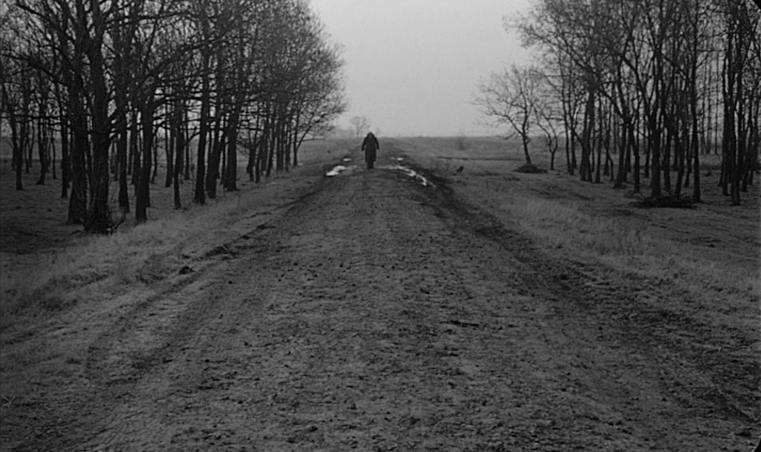
“Everything, everything is lost forever… and those many noble, great and excellent people just stood by…”
In the days following the passing of cinema titan Béla Tarr, I was hit with a flurry of interview footage and text about him online. One such interview asked him if he was an optimist or pessimist, and the director, who for so long had left me beaten over the head with distress, recontextualised his entire career with a simple comment. He claimed that he must surely be an optimist, if only slightly, because he takes the camera and he films and he puts the film out there for people to understand, whereas a pessimist would not even bother to bring themselves to film in the first place.
His work dealt with humanity at its most shattered. Truly shattered, desperate or resigned, and condemned. His films lived out amongst oppressive rain, roaring wind, the muck and gravel, but hearing him call himself an optimist shuffled everything around. It seemed as though he was the only person in the world who could see to the end of time, with his ruined, empty landscapes and spiritually desolate characters representing the end-point for humanity on its current trajectory. A fiercely political and abrasive filmmaker, Tarr’s place in cinema was unsettled somewhat with an overblown image of his work as physically torturous and overly cynical to the point of nihilism. People nowadays joke of “pretentious” cinema that is 8 hours long, with one long take and from the perspective of some obscure being set in an Eastern Bloc nation. This can only really have stemmed from Tarr’s work. This always bothered me because, besides displaying a very narrow perception of cinema, it was a real misrepresentation of Béla Tarr’s body of work. While I seldom saw him as an “optimist” until recently, I always felt his films were clear warnings rather than cut-and-dry representations of our present world. His feelings towards the various Hungarian regimes he lived through, and wider fascist entities, were undeniable, and they were part of what made his art so affecting, but his images of people were far more dynamic than many give him credit for. Whether it be the fallout of broken community in the seminal Sátántangó, or the ease in which collective violence and hatred are ignited and enabled in Werckmeister Harmonies, Tarr existed to capture visions of desolation and hell, but not necessarily to set them in stone.
He was fiercely passionate and uncompromising about cinema, and while this lent to his identity as an abrasive director (formally and as a strong anti-cinema-industry figure), it also meant he was passionate and uncompromising about people. His entire body of work is moulded around people and their interior lives, how they play out within turbulent political landscapes, existential threats, and what that, in turn, means for them. His films got to the core of what it means to be alive, and where aliveness goes when it is pummelled into the dirt by great natural and unnatural forces. The loss of Béla Tarr comes during the worst possible moment, as the cinema industry continues to fall further and further into a Tarrian abyss. The desecration of our world has taken on new features, and now we have one less great holding the form accountable. Thus, accountability and interest are what made Tarr’s work so important. He was right, he wasn’t a pessimist, as is evidenced by that profound interest in people and their personal and systemic failings. He found a beauty in what seems abjectly ugly or rather un-beautiful; peoples’ despair and consequences, the Earth’s beaten land. Where some might shoot a sunrise, he shoots the bullet-like rain. I do believe he was a genius, one of very few.
So Béla Tarr brought his camera out into the world, he continued to film as he got deeper into the Earth, and deeper into the throes of the systems and sicknesses that suffocate the people, and what he brought back was an image. A perversely comforting image at the end of the world where, for the worlds within his films, the damage has been more than done, but for our world, must be avoided at all costs.